Real vs Fake Vapes: How to Spot Counterfeits in 2026
Reading Time: 8 minutes
The problem with real vs fake vapes is getting worse every year. In 2026, counterfeiters have become so sophisticated that the differences between real vs fake vapes are harder to spot than ever before. They copy packaging, flavors, strain names, QR codes, holograms, and batch numbers so well that most people can’t tell the difference anymore.
This guide breaks down everything you need to know about real vs fake vapes—no fear, no hype, no scare tactics. Just real information from someone who has seen inside the industry.
Why Fake Vapes Exist (Follow the Money)
Understanding real vs fake vapes starts with understanding profit margins.
Real vs fake vapes differ dramatically in production cost. A real, licensed vape brand has to pay for lab testing, licensed manufacturing, compliant packaging, taxes and licensing, distribution networks, quality hardware, and real oil or distillate.
A counterfeiter pays for empty packaging shells, cheap hardware, untested oil or distillate, and fake stickers and holograms.
The cost difference is massive. A fake vape might cost $2-$4 to produce and sells for $20-$40. Real products have much higher costs built in. That’s why the counterfeit market keeps growing—the margins are too good to ignore.
What Changed in 2026: Real vs Fake Vapes Got More Confusing
Counterfeiters got smarter. When comparing real vs fake vapes today, they now copy:
- QR codes (including fake verification websites)
- Batch numbers with laser-like precision
- Holograms and security features
- Strain names and packaging design
- Child-resistant seals and safety labels
This means you can’t rely on just one thing anymore. A QR code alone won’t cut it. Packaging alone isn’t enough. You need a full checklist to protect yourself when distinguishing real vs fake vapes.
The Fast Version: 10 Red Flags for Real vs Fake Vapes
If a vape shows two or more of these signs, you’re likely dealing with a fake:
- Packaging looks too glossy or too dull
- QR code links to a random website (not the official brand site)
- Batch number looks printed instead of stamped
- Oil is crystal clear or very dark (not golden/amber)
- Oil moves too fast or looks watery
- Hardware feels light and cheap
- Airflow holes are uneven or ragged
- Flavor tastes chemical or artificial
- Hit feels harsh or burns your throat
- Price is significantly lower than market rate
- Seller has no business license or credentials
Trust your gut. If something feels off, stop using it.
Real vs Fake Vapes: Packaging Details (First Sign of a Counterfeit)
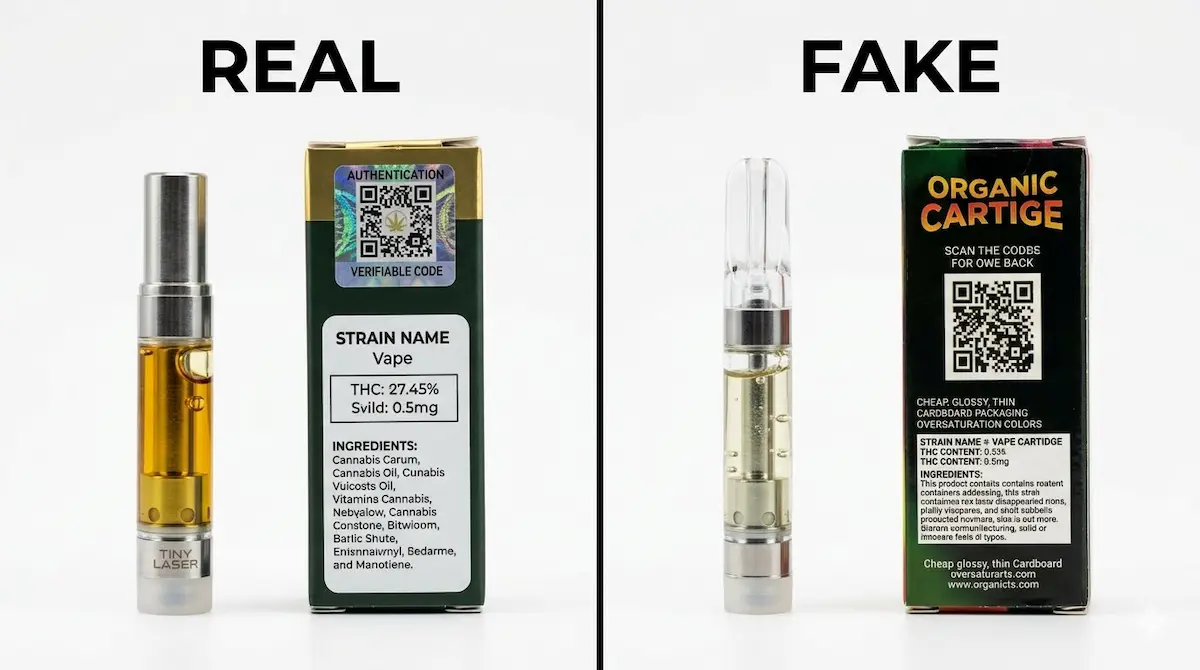
Counterfeiters copy packaging, but they rarely get it perfect. Here’s what separates real vs fake vapes at first glance:
Gloss and Finish
Real packaging has a consistent matte or satin finish, clean and sharp edges, and no smudges or inconsistent coloring. Fake packaging often has an overly glossy or dull finish, blurry or pixelated printing, and uneven colors with visible printing lines.
Font Quality and Spacing
Real brands use professional typography with even letter spacing and correct font weights and sizes. When looking at real vs fake vapes, fakes often have stretched or compressed fonts, uneven spacing between letters, visible misspellings, or the wrong font entirely.
Holograms (If Present)
When you look at a real hologram, it shifts color cleanly when tilted, has sharp and defined edges, and doesn’t peel or scratch easily. It feels integrated into the packaging itself. Fake holograms look flat and static, peel off easily, have fuzzy or blurry edges, and feel like cheap stickers.
Batch Numbers and Codes
Real batch numbers are stamped or laser-etched (not just printed), match the QR code information, match the lab test batch number, and make sense for the product. Fake batch numbers are printed as part of the original packaging, repeat across different strains, don’t match any lab test results, and look like they were added later.
Real vs Fake Vapes: Hardware Quality (The Easiest Giveaway)
Hardware is where the differences between real vs fake vapes are most obvious. Cheap hardware can’t hide.
Weight and Build Quality
Real hardware feels solid and substantial, has balanced weight distribution, consistent thickness throughout, and uses premium materials like anodized aluminum. Fake hardware feels light and hollow, has uneven weight distribution, thin or fragile construction, and uses cheap plastic or thin metal.
Airflow Performance
Real airflow is smooth and consistent, doesn’t whistle or rattle, feels intentional and engineered, and adjusts cleanly if it’s adjustable. Fake airflow whistles or squeaks, feels tight or restricted, varies inconsistently, and has visible manufacturing defects.
Coil Quality
Real coils heat evenly across the surface, don’t burn or blacken the oil, don’t cause sparks or crackling, and last for multiple uses. Fake coils burn too hot (taste burnt on first hit), burn unevenly with some areas scorched, cause harsh and chemical-tasting hits, and die quickly or stop working.
Mouthpiece and Seals
Real mouthpieces fit snugly without wiggling, don’t leak, feel smooth to use, and seal properly to prevent drying. Fake mouthpieces wiggle or come loose, leak oil or distillate, have rough or sharp edges, and pop off unexpectedly.
When comparing real vs fake vapes, if the hardware feels cheap, the rest of the product probably is too.
Real vs Fake Vapes: The Oil (Truth Can’t Hide Here)
Oil tells the truth about real vs fake vapes. Fake oil cannot hide its identity.
Color Test
Real oil is typically golden to deep amber, consistent throughout the cart, not neon yellow or green, and not dark brown or black unless it’s a specific product. Fake oil often appears water-clear (untested, low-quality distillate), neon yellow or bright green, muddy brown or very dark, or inconsistent in color within the same cart.
The color depends on the extraction method and strain, but extremes are a red flag when examining real vs fake vapes.
Viscosity (Thickness) Test
Real oil should move slowly when you tilt the cart, thicken in cold temperatures, thin out when warmed, and not separate from the cartridge walls. Fake oil moves too fast or flows like water, stays thin even in cold, looks watery or separated, and pools at the bottom unnaturally.
The Bubble Test
Real oil bubbles move slowly (takes 2-5 seconds to fall), stay in place if you tilt gently, and are consistent in size. Fake oil bubbles move rapidly (fall in under a second), float quickly to the top, and pop or disappear.
Smell Test (Initial)
Real oil should smell like cannabis (earthy, herbal) or terpenes (fruity, citrus, pine, etc.). It should never smell artificial or chemical. Fake oil often smells strongly chemical or artificial, like perfume or air freshener, or smells synthetic or off.
Real vs Fake Vapes: Lab Tests (Your Strongest Verification Tool)
Lab tests are the strongest proof when determining real vs fake vapes. They’re also the easiest to fake if you don’t know what to check.
What Real Lab Tests Include
A legitimate lab report should have batch number (matches your product), test date (recent, not months old), cannabinoid profile (THC, CBD, CBN, etc.), terpene profile (listed by percentage), pesticide results (passed/clean), residual solvent results (passed/clean), lab name and license number, and lab contact information.
Red Flags in Lab Tests
Fake or misleading lab tests often have generic “PASS” with no details, missing batch numbers, no test date or old test dates, no lab name or license, strain names that don’t match your product, THC percentages that don’t match the packaging, or identical results across multiple products (labs vary).
How to Verify a Lab Test (Step by Step)
Step 1: Scan the QR Code
The QR code should lead to the brand’s official website or the lab’s official website, not a random URL or shortened link. Make sure it uses HTTPS (secure connection).
Step 2: Match the Batch Number
Check that the batch number on your cart or package matches exactly on the lab report. It shouldn’t appear on multiple different products.
Step 3: Match the Strain Name
Your product says “Blue Dream,” and the lab report should say “Blue Dream.” It shouldn’t say “Strain #47” or use generic names.
Step 4: Match the THC Percentage
Package says “92% THC,” and the lab report should say approximately 92% THC. Small variance is normal (allowing ±2%), but major differences are a red flag when verifying real vs fake vapes.
Step 5: Verify the Lab
Look up the lab’s license number on the California Department of Cannabis Regulation website. Visit the lab’s official website and confirm the lab is on the state’s METRC system (Cannabis Track and Trace).
Step 6: Check the Test Date
Test dates should be recent (within 6 months), not months old or outdated. The test date should match the product’s age.
If anything doesn’t match, stop using the product immediately.
Real vs Fake Vapes: Price (The Easiest Red Flag)
If the price is too good to be true, it’s fake. Understanding the price difference between real vs fake vapes is critical.
Real licensed vapes cost more because they include taxes and licensing fees, mandatory lab testing, quality hardware, compliance and legal overhead, and distribution markup. Fake vapes skip all of that.
If someone is selling a $45 cart for $20, a $60 disposable for $25, a “brand new” premium device at 50% off, or bulk deals that seem impossible, you’re looking at counterfeit products.
Real prices have range based on retailer markup (different shops charge different prices), location (California prices vary by region), sales and discounts (seasonal deals, loyalty programs), and product type (disposables vs. carts cost differently).
But a 50% discount across the board isn’t a sale. That’s counterfeit. The difference between real vs fake vapes in price is usually obvious.
Where Fake Vapes Are Most Common
Fake vapes show up most in unlicensed shops or gas stations, online marketplaces (certain platforms), social media sellers (“DM for menu”), Telegram, Snapchat, and Instagram “plugs,” street vendors, and unverified delivery services.
The common thread is always the same: no license, no accountability, no transparency.
In fact, the FDA has issued warnings about counterfeit cannabis products, noting that fake vapes are increasingly confusing consumers and putting them at risk.
How to Avoid Fake Vapes When Buying Online
In 2026, online counterfeit vapes are everywhere. Knowing the differences between real vs fake vapes is your best defense.
Don’t buy from: Instagram sellers or “Instagram storefronts,” Telegram or WhatsApp “connects,” Snapchat dealers, TikTok promotions, “DM for menu” accounts, random websites with no business info, sellers with no license or credentials, or too-good-to-be-true pricing.
Do buy from: Licensed delivery services (can show their license), licensed dispensaries, official brand websites, established retailers with verified information, sellers who provide lab tests upfront, and services that require age verification.
When in doubt, ask for proof. A real business has a license number you can verify, lab tests you can check, a physical address, a phone number, and real customer reviews.
How to Verify a Vape Brand Is Real
Every real brand has an official website with real contact info, a verifiable license from the state, a batch verification page (QR code check), real lab tests available for download, real customer support (email, phone), consistent packaging across batches, and a physical address (not just a PO box).
If a brand has none of these or only has a social media page, it’s not real.
If you’ve never heard of a brand, search “[Brand Name] + California license” before buying. Real brands show up in state records.
The 10-Second Real vs Fake Vapes Test
If you only have a few seconds to check, focus on these four things:
- Check the oil color and movement (golden/amber with slow movement is good)
- Check the hardware weight (solid feeling is good)
- Check the QR code destination (should go to official brand website)
- Check the price (should be normal market rate)
If two or more things feel off when comparing real vs fake vapes, stop using it and buy from a licensed source.
What to Do If You Already Used a Fake Vape
Stop using the product right away. Throw it away safely and dispose of it properly rather than giving it to someone else. Don’t buy from that seller again, and report them if possible. Going forward, buy only from licensed dispensaries or verified retailers.
If you have concerns, contact your doctor or poison control. Most people are fine though—counterfeit vapes are usually just low-quality, not necessarily dangerous.
The Bottom Line: Protect Yourself by Understanding Real vs Fake Vapes
Fake vapes aren’t going away. They’re getting better, faster, and harder to spot every year. Understanding the differences between real vs fake vapes is your best protection.
But with the right information, you can protect yourself. Use this checklist every time:
- Check packaging quality
- Inspect hardware durability
- Verify oil appearance and movement
- Confirm lab test accuracy
- Check the seller’s credentials
- Compare price to market rate
- Trust your gut
This is the real operator playbook. It works.
Buy from Los Angeles Vapes—Licensed, Verified, Transparent
We understand the fake vape problem because we compete against it every day. We know the differences between real vs fake vapes better than anyone.
That’s why we source from licensed brands only, provide lab tests for every product, verify batch numbers in real-time, offer same-day delivery with ID verification, have a transparent returns policy, and stand behind every product we sell.
When you buy from Los Angeles Vapes, you’re buying peace of mind.
Questions About Real vs Fake Vapes?
Have questions about spotting fakes? Want to verify a product you already own?
Contact Los Angeles Vapes at any time:
We believe in transparency. That’s what separates us.
Related Reading
- How to Choose the Right Vape for You
- Understanding Lab Tests: A Beginner’s Guide
- Vaping vs. Smoking: The Complete Comparison
- Los Angeles Vape Regulations: What’s Legal in 2026
Last Updated: May 2026
Author: Los Angeles Vapes Operations Team
Fact-Checked: Industry standards and California regulations

Author Name: Los Angeles Vapes Operations Team
Email: jason@losangelesvapes.com
Website (optional): https://losangelesvapes.com
Comment:
Great question! Thanks for reading our real vs fake vapes guide.
One thing we want to add based on reader feedback: always check the QR code with your phone’s camera before buying if possible. Some counterfeiters now use QR codes that lead to fake verification pages that look real at first glance.
A few pro tips we’ve learned since publishing:
1. Scratch-off verification stickers – Real brands in California often use scratch-off codes under the QR code. If the sticker is already scratched when you buy it, that’s a major red flag.
2. Batch number placement – Real batch numbers are usually stamped into the box or carton, not printed flat. Run your finger over it. If it feels smooth (printed), be suspicious. If it feels indented (stamped), that’s a good sign.
3. Oil smell test – This one surprises people. Real cannabis oil has a distinct plant-like smell. Fake oil often smells like a candle or air freshener. Trust your nose.
4. Check the lab’s website directly – Don’t just scan the QR code and trust what loads. Type the lab’s URL manually into your browser and search for the batch number there. This bypasses fake QR code redirects.
We’re updating this guide monthly as counterfeiters evolve. If you spot something we missed, drop a comment below and we’ll investigate.
Stay safe out there.
– Los Angeles Vapes Team